
The Lockheed Vega and the Birth of Burbank’s Golden Age
Burbank, California, is world-renowned today as the "Media Capital of the World," but before the silver screen took over, the city’s pulse was driven by the roar of radial engines and the scent of aviation fuel. The catalyst for this transformation? A sleek, wooden wonder called the Lockheed Vega.
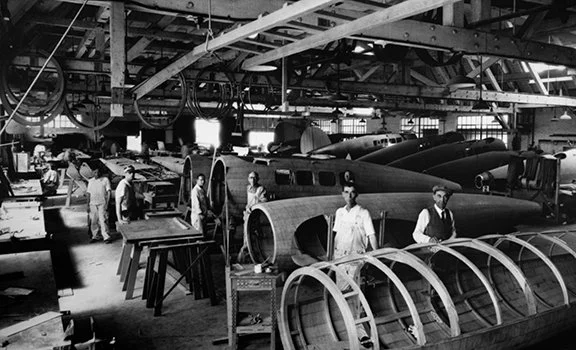
Lockheed Vega wood fuselage shop
When Lockheed moved its operations to a former glass factory in Burbank in 1928, it wasn't just moving shop—it was launching an era that would define the San Fernando Valley for a century.
The Arrival of the Vega
While Lockheed had produced aircraft before, the Vega was the first to be manufactured at the new Burbank plant. Designed by the legendary Jack Northrop and Gerard Vultee, the Vega was a radical departure from the boxy, wire-braced biplanes of the era.
Monocoque Construction: It featured a revolutionary "eggshell" fuselage made of molded plywood, making it incredibly light and aerodynamically "clean."
The Speed Demon: Because it lacked the drag of external struts and wires, it became the preferred ride for record-breakers.
The Pilot's Choice: Icons like Amelia Earhart and Wiley Post chose the Burbank-built Vega to cement their places in history.
Why Burbank?
In the late 1920s, Burbank was largely agricultural, known more for its fruit groves than its factories. However, the Allan brothers (Allan and Malcolm Loughead) saw potential in the wide-open spaces and the proximity to a growing Los Angeles.
By setting up at the corner of Empire Avenue and Kelton Street, Lockheed didn't just build a plane; they built an ecosystem. The manufacturing of the Vega required a specialized workforce—machinists, woodworkers, and engineers—who began to flood into the area, trading tractor seats for drafting stools.
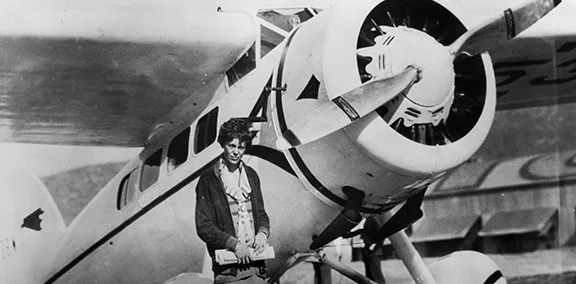
Amelia Earhart’s Vega 5B
Amelia Earhart purchased her Vega for $13,900 for her historic solo, nonstop transatlantic flight on May 20–21, 1932
A New Era for the Valley
The success of the Vega put Burbank on the map. It proved that the city could handle high-tech manufacturing at scale. This set the stage for:
The Expansion of United Airport: Now known as the Hollywood Burbank Airport, it grew alongside Lockheed to accommodate the testing of these new high-performance machines.
The "Skunk Works" Legacy: The footprint established by the Vega eventually allowed Lockheed to expand into the massive complex that produced the P-38 Lightning, the U-2, and the SR-71 Blackbird.
Economic Resilience: Even during the Great Depression, the aviation industry provided a backbone for Burbank that many other Southern California towns lacked.
The Legacy Today
Though the massive Lockheed plants have since been replaced by shopping centers and movie studios (like Disney and Warner Bros.), the DNA of the Vega remains. Every time you fly into Burbank or walk through the Empire Center, you are standing on the grounds where a wooden monoplane first proved that Burbank was destined for the clouds. Vega wasn't just Lockheed's first Burbank success; it was the spark that ignited an industrial revolution in the heart of the Valley. It taught a small farming town how to fly.
